

tree ornaments
I’m a week late with this blog because I was away from my desk while visiting family.
Over forty years ago I moved five provinces away from my home, leaving behind all of my relatives. It was a wrench to leave, but I was young and hopeful and soon settled into a new life in my new home. Like other transplants, I sent back bragging letters to brothers still negotiating snow drifts while I revelled in cherry blossoms, (a common symbol of early spring).
Of course, as time went on babies were born into my immediate family “back home,” babies that I didn’t meet, sometimes for years. Then, those babies grew up, got married and had more babies and my connection to the expanding family grew more tenuous. As an antidote, I created handmade Christmas ornaments to send to all those babies. My plan was that each child would get an ornament a year for eighteen years. (When I started setting up my own Christmas tree I had to start from scratch, so my plan was that each child would have at least 18 ornaments of their own when they set up their own tree.) I hoped that these small tokens would remind the next generations that they had an aunt “out west.”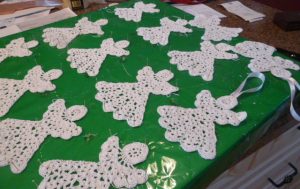
Imagine my delight when I met great nieces and nephews last week who immediately identified me as “the ornaments!” and recounted how much they enjoyed putting them onto their tree every year and the stories that were told around them. My little “remember me” plan had succeeded beyond anything I’d imagined.
In the market, those little mementos would be worth mere pennies, but they symbolize family and kinship and generations of shared heritage. Their value as a symbol, or touchstone, is beyond price.
Symbols can hold that kind of power in our writing, as well. Consider “Rosebud” in Citizen Kane. The monetary value of a child’s sled would be nothing to a man as wealthy as Kane, yet the memory of it shapes his whole life. It is the last word on the lips of a dying man.
In the Great Gatsby, Fitzgerald uses the green light at the end of the dock to symbolize Gatsby’s hopes and dreams.
The wicked step-mother from fairy tales e.g. Cinderella, is so pervasive the mere mention of a step-mother in fiction conjures up all kinds of mean and nasty characteristics.
Touchstones aren’t always objects or people. In my book, The Man for Her, the gold rush is a touchstone for Lottie, not as a means to riches, but as a symbol of all she has lost. She refuses Sean’s love when he decides to join the hunt for gold.
My short story, “The Man Who Loved Christmas” the phrase “what a beautiful mess,” is a touchstone for a grieving family.
In Writing the Breakout Novel, Donald Maass says symbols “pack a powerful lot of meaning into a small package.” As writers we want our prose to be powerful and meaningful. If a symbol can do that in a small package, so much the better.
I’ve taken dozens of workshops on writing, read volumes and volumes of “how to write” guides and studied literature at university level, but there is nothing like lived experience to drive home the lessons. Symbols are powerful. Touchstones shape our family stories. They can be just as impactful in our stories.
Have a look at your current writing project and see if you have already included a symbol unintentionally. If you have, give it a little more space, repeat it here and there and you’ll find it enhances the emotional grip of your tale. If there is no object of phrase or landscape that symbolizes a theme in your book, try to incorporate one, without forcing the issue. It’ll add “polish” to your prose.
What is your favourite example of symbolism in a novel or movie? Click the comment button at the top of this post to share your answer.


Leave a Reply