

chatting with a friend
Any beginner’s writer course will tell you to know your audience and to write for that audience if you want your work to be a commercial success. Most writers want to attract as many readers as possible in order to sell lots and lots of books. This post of six tips from Ingram Sparks is a prime example, of this advice and a good place to start when considering your market plan.
As many readers as possible seems axiomatic. I was surprised, therefore, when I read the author’s notes in the latest Jan Karon book, where she says she writes “to just one person: you.”
Huh? Just one person? A letter is written to just one person, usually, but people who write (and sell) books want thousands to read them. Even Jan Karon admits that she hopes for many readers. Yet she targets her writing to “one.”
The idea of imagining the one person who will read our books can be scary. How many authors have you heard worry that “my mother might see it” and tone down their bawdy heroine? How many authors use a pseudonym to avoid that “one person” who insists that a work of fiction is an autobiography? There are good reasons why an author might want to write to a huge but anonymous audience.
Still, writing for only one reader raises intriguing possibilities.
While we’d all like a wide audience — “anyone can enjoy my book,” may be true but it won’t get your story into a publishing house or find readers through independent publishing–in order to sell your book, you need to appeal to a reader’s particular taste. Anyone can enjoy a story that features a unicorn, but only a certain segment of the population will make that the sole criterion for purchasing a book.
So, if I’m considering the “one” person I write to, who would she be? I say she, because I expect my audience to be largely female. The first choice she’ll make before buying a book is between fiction and non-fiction. Since I’m a romance writer, I aim my work toward readers of fiction. Now, I choose between literary or genre fiction. In my case, I write genre fiction, specifically romance, and even more specifically historical romance, set in Canada. Each of those choices I make, narrows my audience, but it also allows me to visualize the “one” reader I’m writing for (to).
My books will be shelved in the “romance” section of a book store, or on-line retailer. If I consider I’m writing for “anyone,” I’ll have a hard time getting my book to market. Sadly, there is no section of a retail outlet that says “anyone.” Even shoppers who like to browse a variety of shelves, have certain biases. A reader who wants a Scottish setting, might try my book because she also wants romance and historical. The reader who wants a thriller will probably never see my titles. After all, if I want new shoes, I won’t shop in the grocery store.
Some publishing advisors recommend creating a profile of your ideal reader. For me, that reader is likely female, likely middle-aged or older, likely of European extraction, likely a history buff. But even with those broad strokes in mind, I can write to a more specific reader. Maybe she’ll have a soft spot for cats. (There are millions of cat videos out there so clearly cats are a big seller!) Since I’m a cat owner of many years standing, I’m speaking from experience if I write a cat into story. 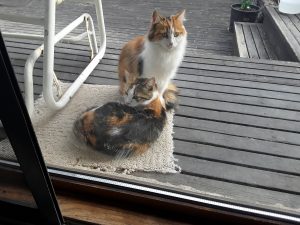
So now I’m writing a letter (book) to an old friend who shares my culture and my love of cats. As I imagine myself talking to this one person, my story-telling becomes deeper and freer. I don’t need to over-explain everything, because I’m just writing to a friend. I can uncover secret longings and confess to failures, because I’m writing to a friend. All of this will shape the story, colour the character of my protagonist, and make the story connect more on a personal level with my one (hopefully many ‘ones’) reader.
Early in my career, the “elevator pitch” was a hot topic. Many writers obsessed with packing as much of the story as possible into one short paragraph that could be recited at top speed to an editor or agent as they rode the elevator together at a conference; in other words, a hard sell. But if you think of pitching your story to one old friend, the “sell” part diminishes. You want your friend to like your book, so you tell her the stuff that will interest her. And that’s the stuff the editor wants to know, too.
Maybe this writing to one reader isn’t as odd as it sounds. I note that Ms. Karon uses “to” instead of “for.” I find that word choice interesting. If I write “for” a multitude of readers, it feels like throwing spaghetti at the wall and hoping something sticks. If I write “to” you, I’m forging a relationship. We’re partners in this book. I put down my vision of the story, and you read it through your experience.
I’m not suggesting writers should ignore all the marketing advice about building a brand, or the craft advice about voice or character arcs, or any of the many, many skills that go into building a profitable career. But I think the idea of writing to “one” friendly reader is worthy of consideration.
What do you think? Click the comment button at the top of this post to share your opinions.


Leave a Reply